Occupational Exposure & Leverage Audit
Five questions. Your occupation is mapped against published estimates of automation exposure, then adjusted for the friction that actually protects work: physical presence, institutional inertia, geography, and your own rate of adaptation.
What do you do
Filter by sector
How physical is the work
Moravec's paradox holds: what is hard for people is often easy for machines, and what is effortless for people is often extremely hard for machines. Hands, sites and rooms are a real shield.
What kind of organization
Where the work happens
Work that can be done from a keyboard anywhere competes with people anywhere.
How you work today
Running the assessment
Why Intelligence Capitalism is worth your time
- See how two people built a $1.8 billion company, and steal the architecture, not the headline.
- Own the customer, outsource the complexity, automate the middle. Try it on your own business this week.
- Run the Fragility Audit and find the one place your company would break first.
- Revenue and headcount split apart in 2023. Better to understand why before it decides your job for you.
- Get a way to choose, govern, and scale one workflow, not another round of AI hype.
Your diagnosis
Where effort is worth shifting
Directional rather than prescriptive. These describe where effort tends to pay off as routine work becomes cheaper, and are meant to be adapted to your own circumstances and pace.
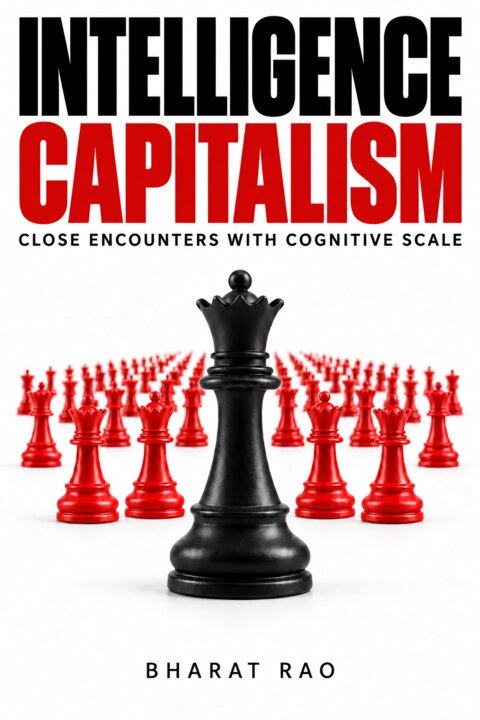
Thank you for taking the audit.
Everything above came out of four minutes and twenty-nine occupations. The argument underneath it, why cognitive work is becoming abundant and what stays scarce when it does, is the subject of the book.
Like to know more? Get your copy of Intelligence Capitalism today.
Get the book