
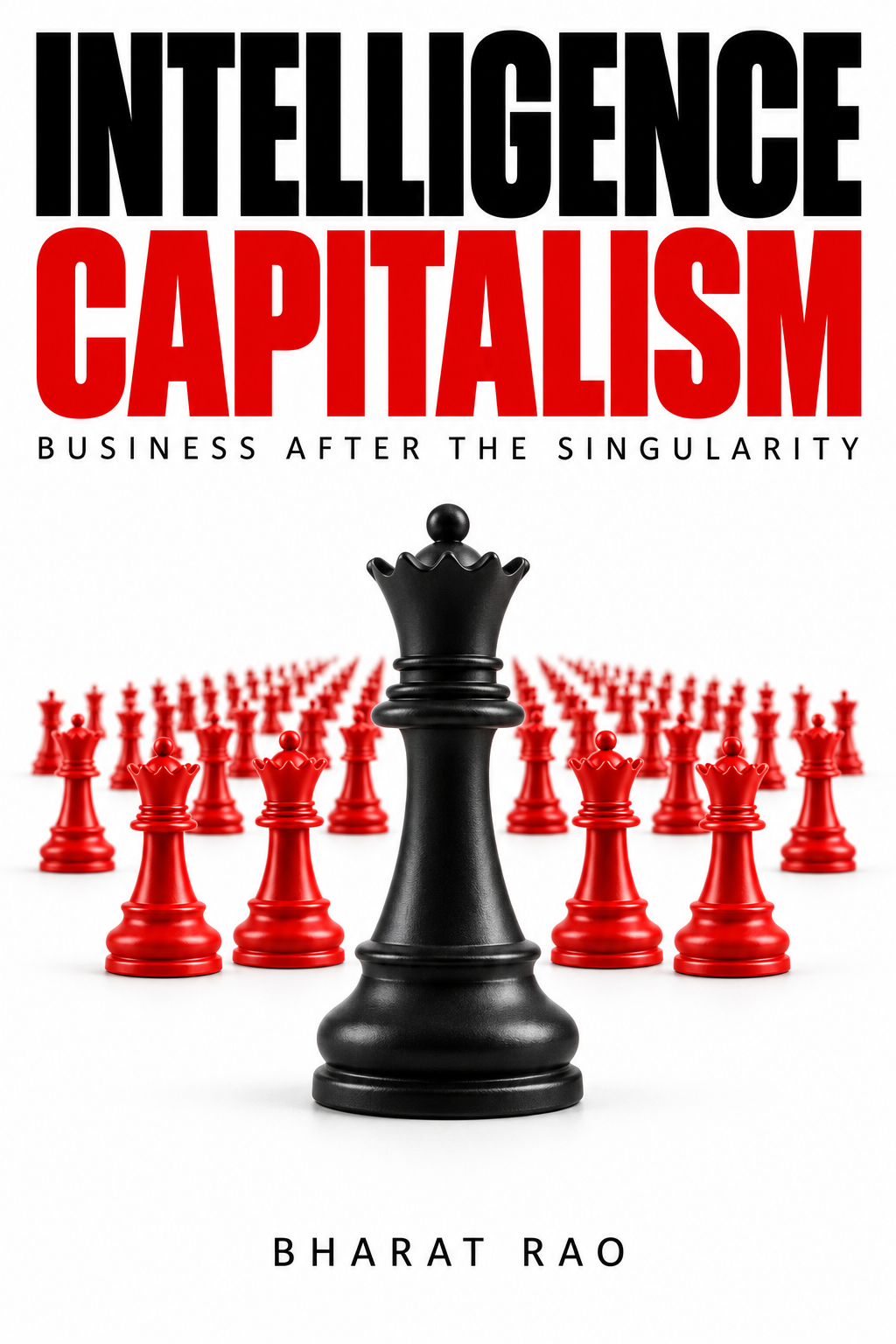
Upcoming nonfiction

Intelligence Capitalism

Business After the Singularity

The relationship between headcount and revenue is breaking. Across seventeen chapters and four acts, Intelligence Capitalism tracks the firms learning to grow their customer base without growing their payroll to match, and the structural risk that leverage creates once it is real.

“The corporate ladder is not disappearing all at once. It is being hollowed out in the middle.”

A four-minute diagnostic mapping your occupation against published automation-exposure research. Nothing you enter leaves your browser.

Intelligence Capitalism: Business After the Singularity, by Bharat Rao, published by Core Loop Press

Leverage, not labor, now determines the winner.

For a century, large firms existed because human judgment was scarce and expensive to coordinate. That arrangement is under pressure. AI does not replace judgment, trust, or accountability, but it can absorb a growing share of the routine coordination that once justified thick payrolls and thick middle layers. Intelligence Capitalism separates a firm into three parts — the customer relationship, which has to be owned; the operational middle, which is most exposed to AI compression; and capital-intensive infrastructure, which can often be rented — and follows that logic through the companies already built on it.

  • The Three-Layer Architecture: what a firm must own, what it should automate, and what it can safely rent.
  • The Seven Laws of Machine Scale, covering headcount, model dependency, data moats, regulation, speed, judgment preservation, and judgment debt.
  • Judgment Debt: the liability a firm accumulates when it eliminates entry-level work without building any pathway to replace the judgment that work used to produce.
  • The Fragility Index, scoring a firm's dependency, compliance posture, apprenticeship pipeline, and exposure to model drift.

Bharat Rao

An educator, researcher, and writer, formerly Chair of the Department of Technology Management and Innovation at NYU Tandon School of Engineering, and the author of several papers, books, and reports on technology innovation.